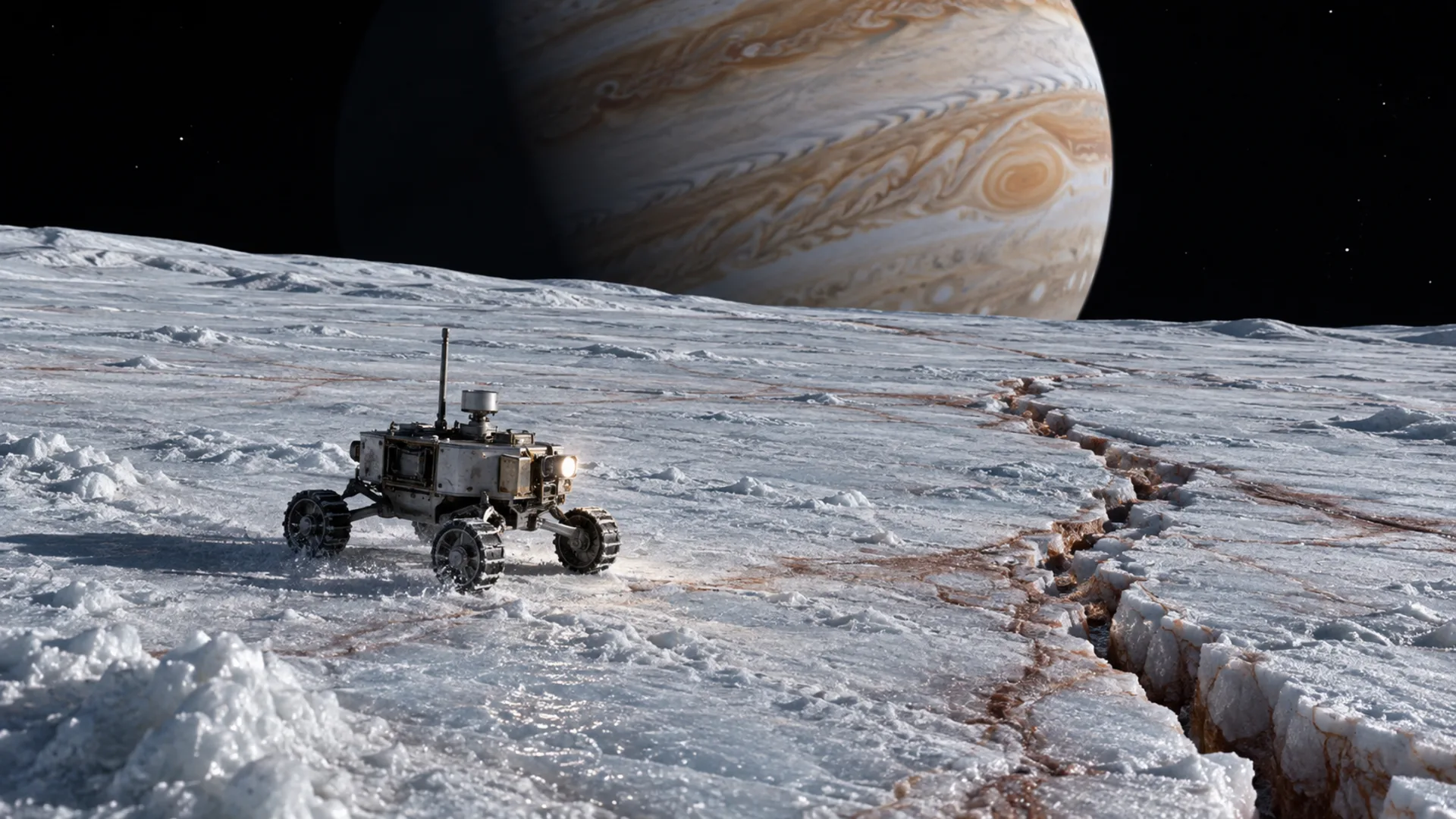
Your spacecraft is dropping through Jupiter’s clouds. The engines still respond, and the dashboard insists there must be a way out. So why can no one tell you where the ground is—or how much time you have left?
The fall begins with a simple plan
Imagine your spacecraft has lost control and is descending toward Jupiter. The obvious move is to find an escape route: steady the cabin, fire the engines, and call for help. The trouble is that every attempt depends on an environment growing less forgiving by the minute.
This is a hypothetical scenario, not an account of a crewed mission. No human has fallen into Jupiter, so there is no real survival countdown. But probes have crossed part of its atmosphere, and they help explain why this story may not end with a landing.
The planet is made mostly of hydrogen and helium. As you descend, the gas grows denser and behaves differently under pressure; there is no clearly defined solid surface waiting to catch a spacecraft.
First, you lose control
In the upper layers, clouds hide the view and winds can push the spacecraft off course. Jupiter has enormous storms and an atmosphere that is constantly moving. You can try to correct your heading, but a compass and a map cannot fix the fact that the route itself is becoming more turbulent.
The humor is not especially reassuring: it is like trying to park in a gale, except the parking lot is an entire planet and nobody can tell you where the space ends.
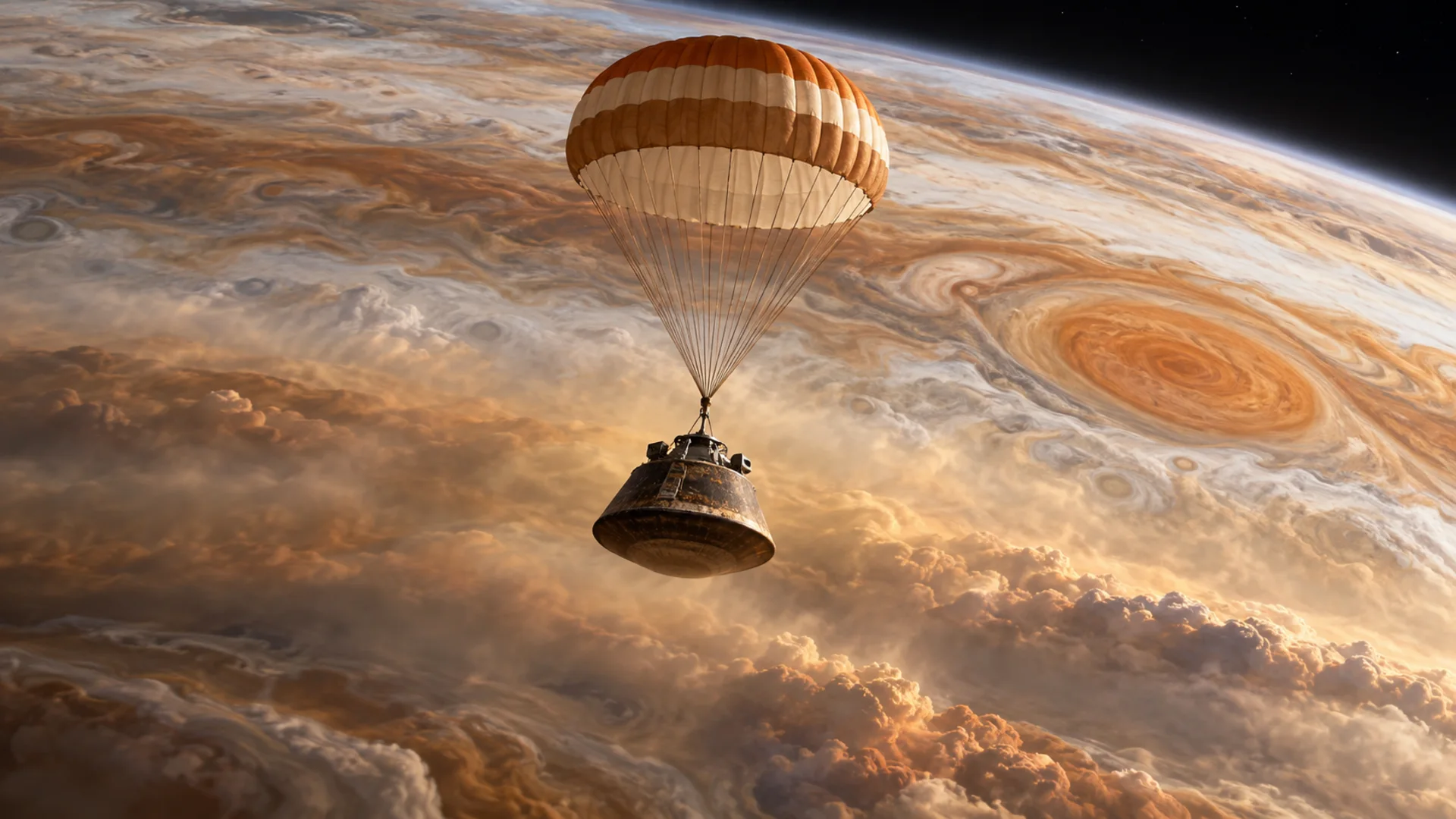
The radio becomes your last connection
Even if the cabin is still working, sending a message home does not guarantee rescue. The distance already makes any reply slow, and the atmosphere itself can cut off the signal. You may hear only static—the conversation ending exactly when it would be most useful.
There is a real, robotic comparison. The Galileo mission’s atmospheric probe entered Jupiter in 1995 and sent data as it descended. NASA reports that its transmission ended 61.4 minutes after entry, when the probe was under pressure of about 22 Earth atmospheres. It carried no people, and that duration cannot predict human survival.
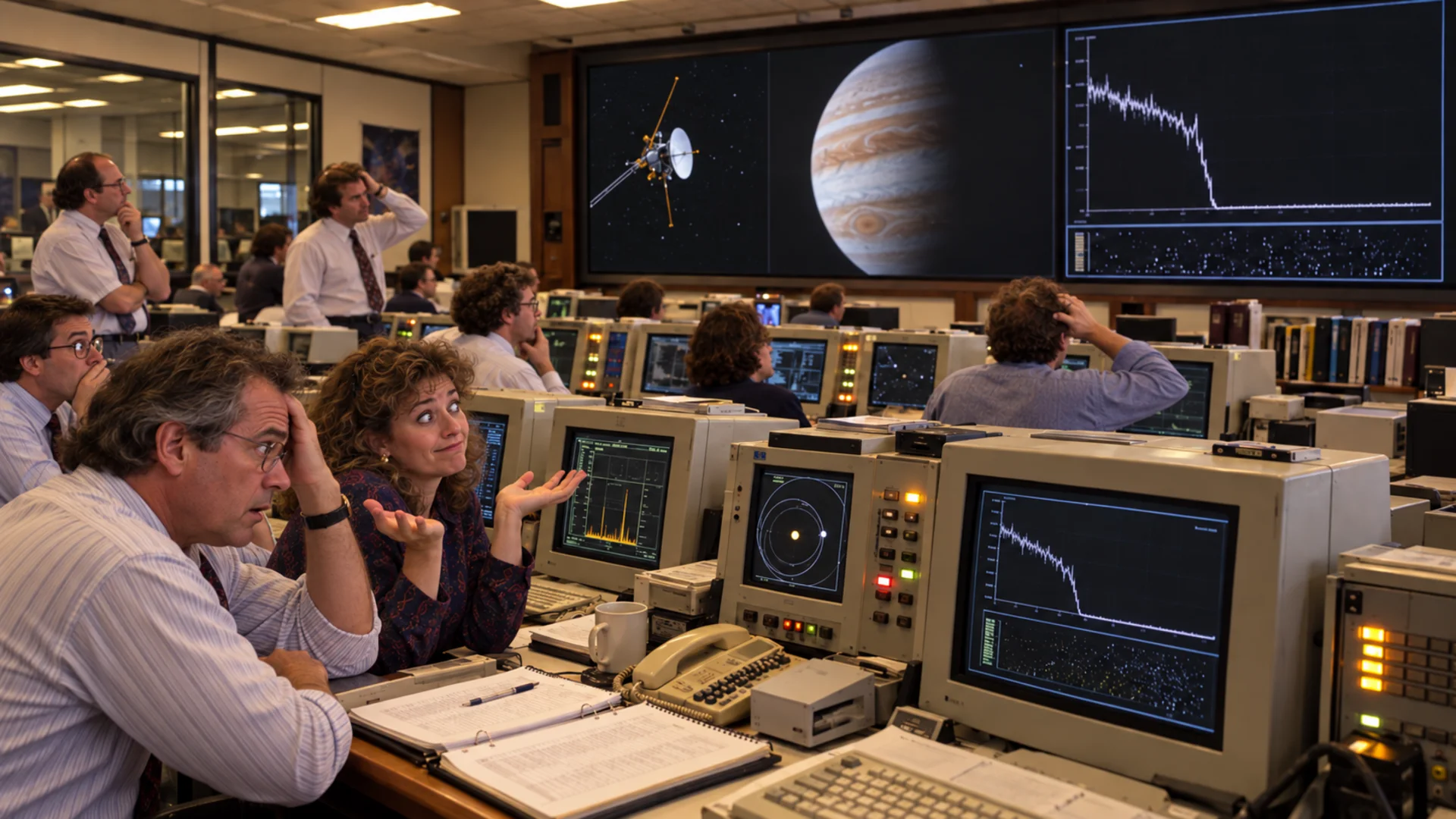
There is no reliable countdown
So how long would you survive? The honest answer is that there is no exact number. The outcome would depend on the spacecraft’s protection, its path and descent speed, and when heat, pressure, and mechanical stress exceeded the limits of the vehicle and life-support systems.
Galileo shows that a machine built for the mission managed to send information for roughly an hour. It does not mean a person would last that long, or that every spacecraft would last the same amount of time. Turning that figure into a countdown would make the data promise more than it does.
Every fix brings a bigger problem
Firing the engines might help briefly, but the spacecraft must remain intact for the maneuver to work. A parachute, like the one Galileo used to slow down, was designed for a particular probe and descent; it is not a universal landing button. The deeper the craft falls, the greater the pressure and temperature become, until materials, instruments, and systems stop working.
A simple demonstration can help picture pressure: an empty can may buckle when outside forces compress it. A real spacecraft is far more complex, but the principle shows why a stronger hull cannot turn an endless descent into a safe trip.

What lies farther down?
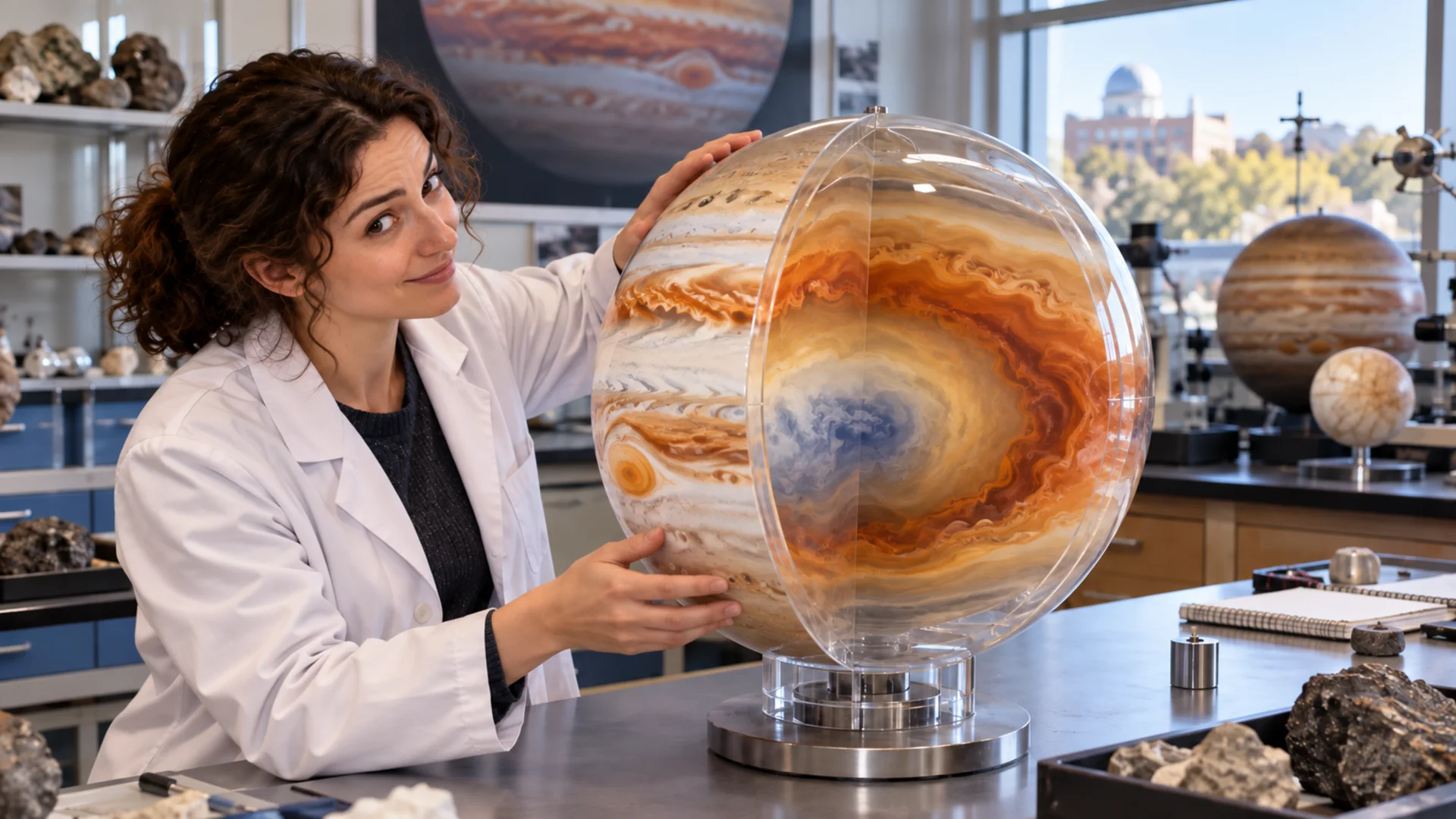
There is no sharp boundary where the pilot could say, “We have reached the ground.” Deep inside, hydrogen is under extreme conditions and behaves very differently from the gas we know. Models and measurements from the Juno mission suggest the interior may have a diffuse core mixed into the surrounding layers, rather than a solid ball with a simple edge.
That does not mean we know every detail of the interior. Its deep structure is still being studied, so “Jupiter may not have a solid surface” is a careful way to say there is no accessible, well-defined floor like Earth’s.
So, what is the answer?
If a spacecraft fell into Jupiter, survival would first depend on how long the cabin and its systems could hold up. There is no confirmed human time limit, and Galileo’s 61.4 minutes describe a probe’s final transmission, not a person’s limit. The likely outcome is losing the spacecraft long before any conventional landing.
The question sounds like “How long until we hit the ground?” On Jupiter, the more important answer is that there may be no ground to hit—only a descent through layers that grow more hostile.
Frequently asked questions
Has a person ever descended into Jupiter’s atmosphere?
No. Galileo was a robotic probe, and no crewed mission has entered the planet’s atmosphere.
Did Galileo survive for 61 minutes?
It sent data during its descent, and NASA records that its signal ended 61.4 minutes after entry. That is not the survival time of a person, nor does it mean the probe remained intact until then.
Does Jupiter have a core?
Measurements point to a complex, possibly diffuse interior. Its exact composition and structure are still being studied, so it should not necessarily be pictured as a solid sphere with a defined edge.