Europa looks like a frozen moon, yet clues on its surface point toward a salty, hidden ocean that may contain more water than all of Earth’s oceans combined. The difficult question is not simply whether water exists, but whether that environment could support life.
A moon with a secret under the floor
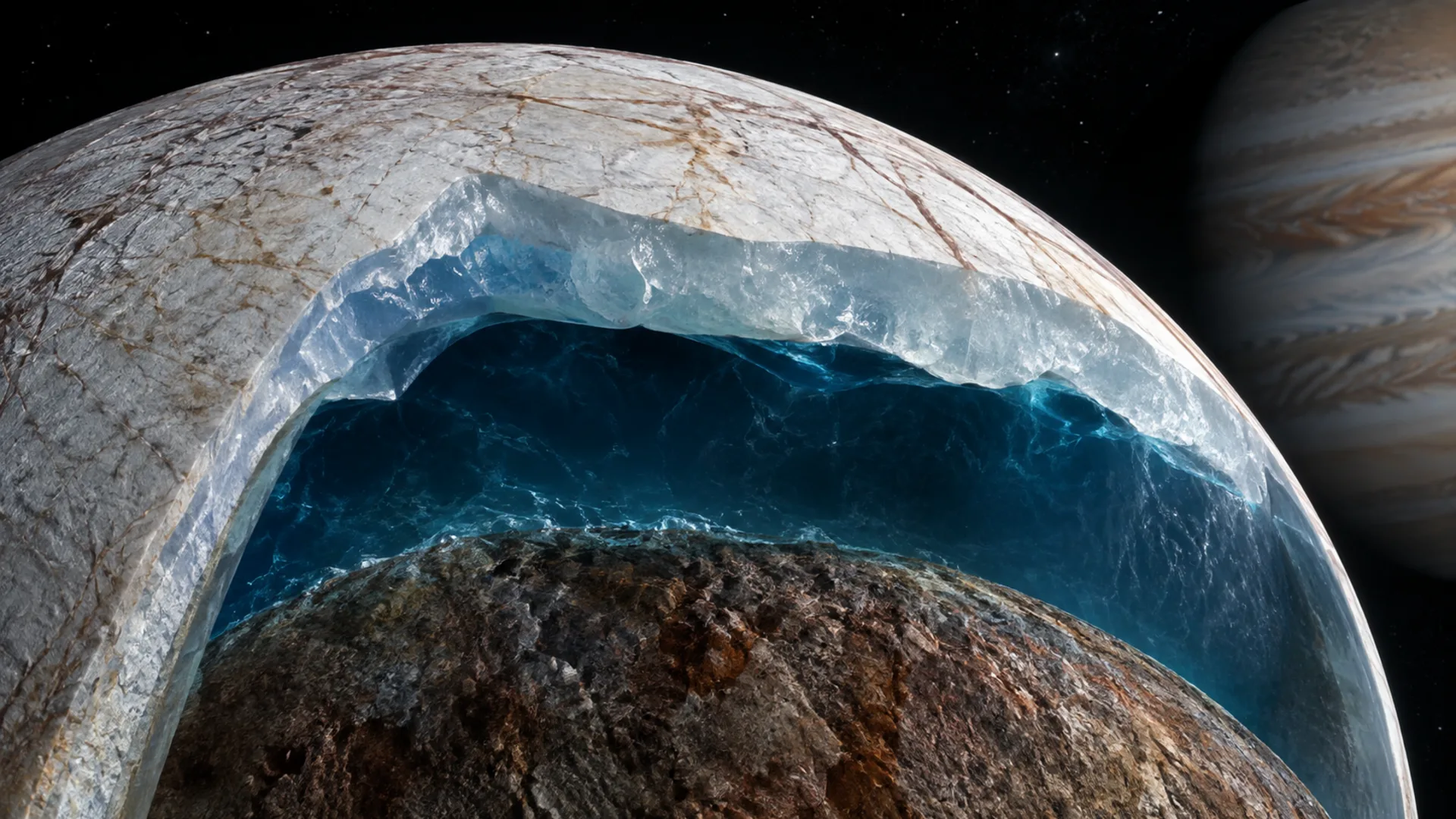
Imagine inspecting a frozen world and discovering that its most important feature is buried beneath kilometers of ice. Europa, one of Jupiter’s major moons, may work exactly that way. From above, it is a bright, fractured body with almost no atmosphere. Below the crust, scientists think there may be a global ocean of liquid water.
This ocean has not been photographed directly. It is an inference built from several clues: the moon’s magnetic response, its fractured geology, the movement of its ice shell, and the possibility of heat from its interior.
It is the first condition in the investigation, not the final answer.
The magnetic clue that changed the case
Between 1995 and 2003, NASA’s Galileo spacecraft studied the Jupiter system and made repeated close passes over Europa. Its magnetometer detected a response that was difficult to explain if the moon were only ice and rock.
The leading explanation is a layer of salty water beneath the crust. Because saltwater conducts electricity, it could respond to Jupiter’s changing magnetic field and create a signal that a spacecraft can measure from above.
The cracks are part of the evidence
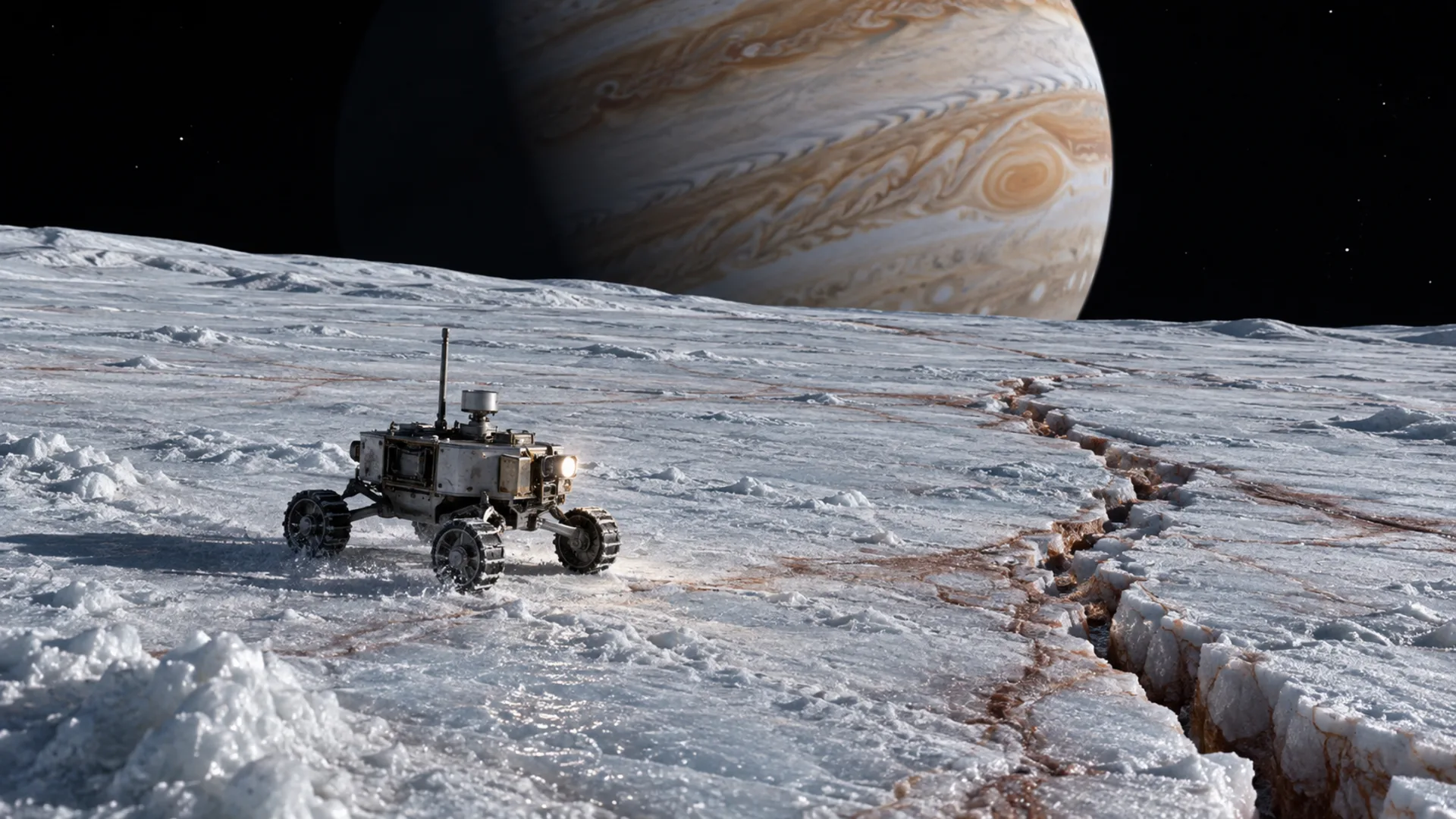
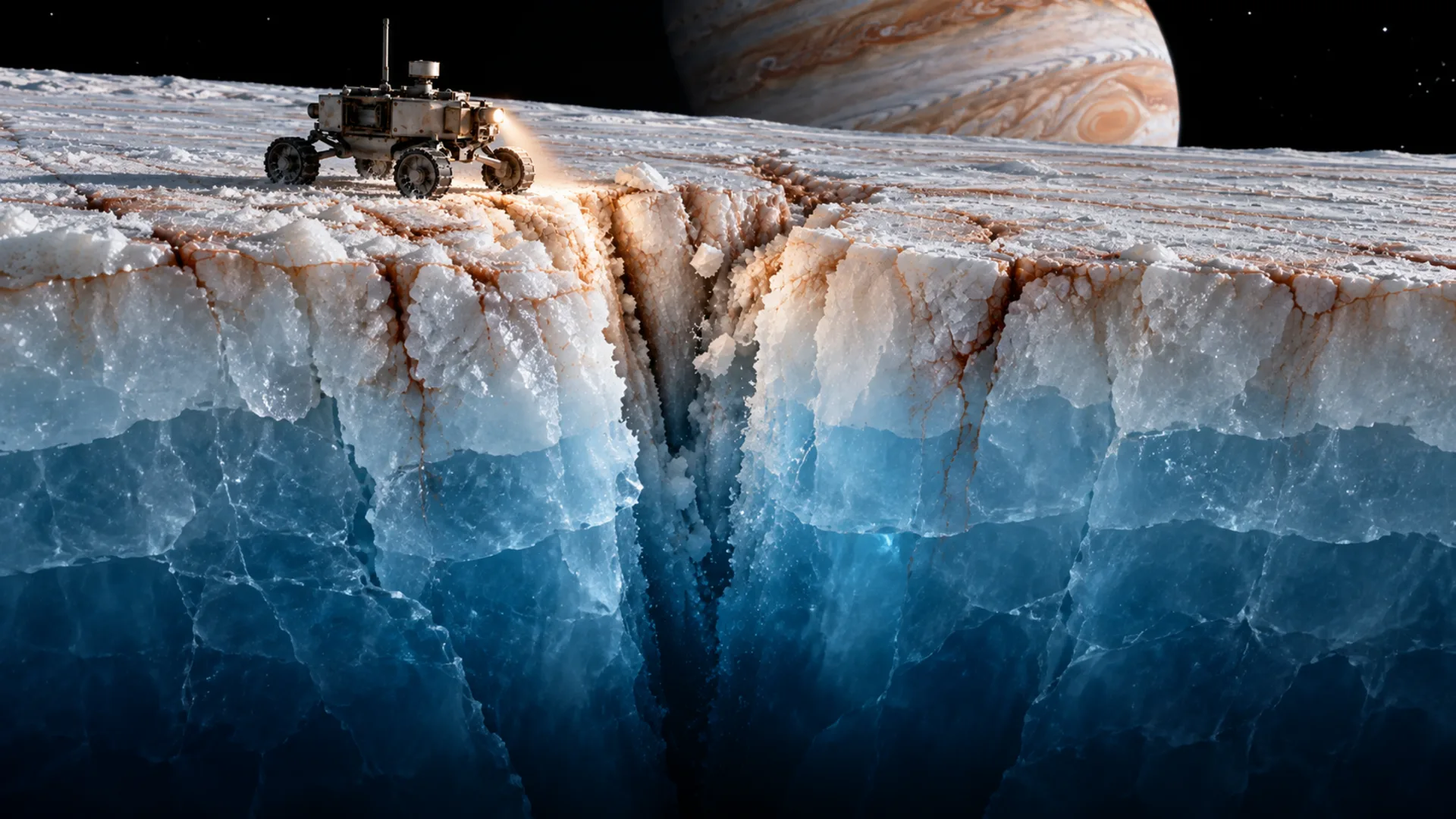
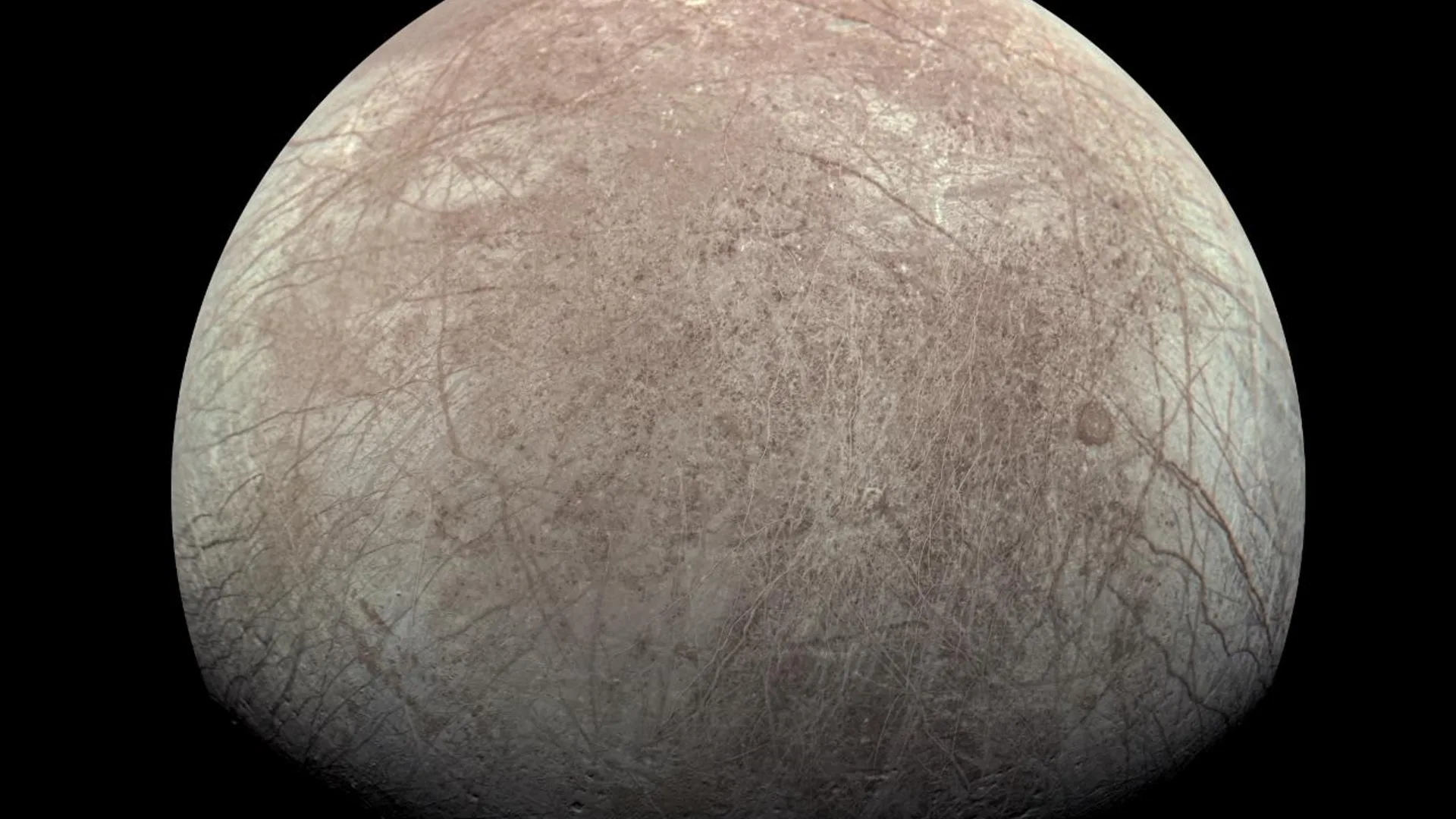
Europa is covered with reddish lines, ridges, and enormous fractures. These marks are more than a dramatic landscape: they suggest that the ice shell is repeatedly deformed as Jupiter’s gravity stretches and squeezes the moon during its orbit.
This process, called tidal flexing, can generate heat inside a moon. On Earth, repeatedly bending an object can warm it; on Europa, the object is an entire world. That internal heating could help keep an ocean liquid beneath the ice.
An ocean larger than ours, but nothing like a beach
Scientific models suggest that Europa’s ocean could contain roughly twice as much water as all of Earth’s oceans. The comparison is impressive, but it would not be a comfortable place to swim: a thick ice shell would cover it, and the rocky seafloor would face immense pressure.
Darkness changes the biology too. Sunlight would not cross an ice shell many kilometers thick, so Earth-like plants could not power a food web there. If life exists, it would need to use chemical reactions, perhaps where water meets warm rock.
The ingredient no photograph can reveal
For life as we know it, scientists often look for three ingredients: liquid water, suitable chemical elements, and an energy source. Europa appears to have the first. Carbon, hydrogen, oxygen, nitrogen, phosphorus, and sulfur may also be present, but finding those elements does not prove that organisms are using them.
Energy is the most intriguing part. Tidal heating could drive reactions between water and rock. On Earth, entire communities live around deep-sea hydrothermal vents without depending directly on sunlight. That analogy shows that Europa could be chemically interesting; it does not show that life has been found there.
A hostile surface above a potentially protected ocean
Europa’s surface presents a sharp contrast to its hidden water. Jupiter surrounds the moon with intense radiation. That radiation can damage complex molecules at the surface and would make exposed life extremely difficult.
At the same time, radiation can alter surface materials and create compounds that might eventually be transported downward. The same environment that threatens life on the surface could help supply chemistry to an ocean shielded beneath the ice.
What has been observed and what remains a hypothesis
There is strong evidence for a subsurface ocean and good reason to study Europa as a potentially habitable world. There have also been observations and models suggesting water-vapor plumes, but their existence, frequency, and composition still require careful confirmation.
No one has found a cell, a microorganism, or an unambiguous sign of metabolism on Europa. Even organic molecules would not settle the question by themselves, because chemistry can produce organic compounds without living organisms.

The investigation ahead
NASA’s Europa Clipper launched on October 14, 2024, to investigate whether Europa has conditions suitable for life. It is expected to reach the Jupiter system in 2030 and make dozens of close flybys using cameras, spectrometers, radar, a magnetometer, and other instruments.
This is not an alien detector. The mission will measure the ice shell, study surface chemistry, map the magnetic response, and examine the connection between the ocean and the interior. Those measurements will help answer whether Europa is merely wet or genuinely habitable.
So, is there life on Europa?
The honest answer is still: we do not know. The ocean appears likely, and its possible ingredients make Europa one of the best places in the Solar System to search for habitable environments. But habitability is a possibility, not a discovery.
Europa may hide microbes under the ice, contain only complex chemistry, or be a sterile ocean with an extraordinary landscape. For now, its greatest discovery is a question: can a world with no sunlight on its surface still have a living story underneath?
Frequently asked questions
Has Europa’s ocean been observed directly?
No. Scientists infer it from magnetic measurements, geological features, and interior models. Future observations must determine its depth, chemistry, and connection to the rocky seafloor.
Does Europa really have more water than Earth’s oceans?
Estimates suggest that its ocean may contain roughly twice the volume of water found in all of Earth’s oceans.
Will Europa Clipper search for life?
It will investigate whether Europa has habitable conditions. The mission is not designed to declare a direct discovery of organisms, but its results can guide future life-detection missions.