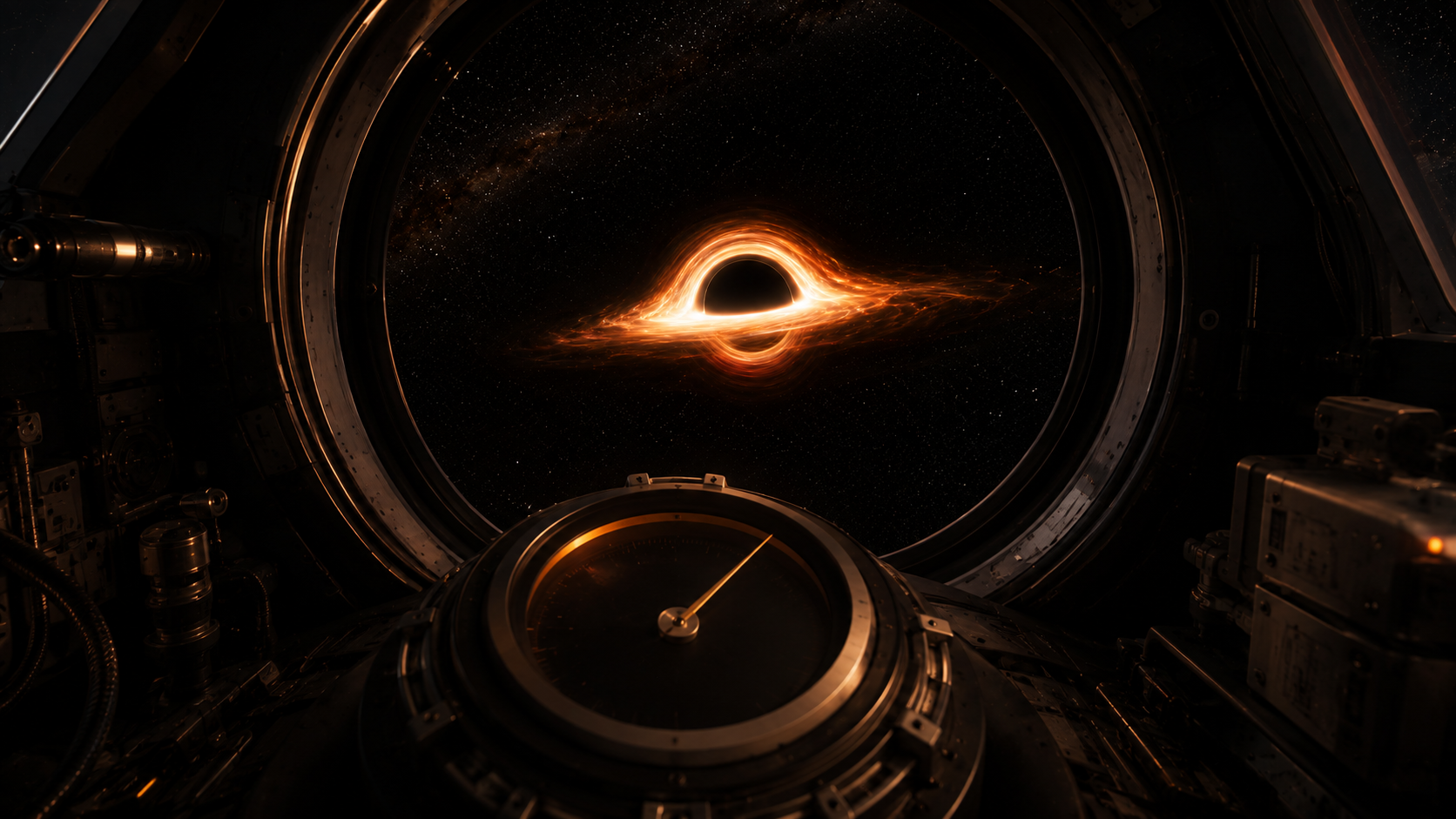
The answer does not begin with an explosion. For an observer crossing the event horizon, the fall could begin in a strangely calm way — before gravity turns the journey into a one-way experience.
First: choosing the “right” black hole
A small black hole formed by the death of a star can produce extreme tidal forces before you even reach the event horizon. In simple terms, the difference in gravity between your feet and your head would be brutal.
A supermassive black hole, such as the one at the center of the Milky Way, offers a less violent initial fall. That does not make it safe. It only means that, in an idealized scenario, you could cross the horizon before being completely stretched apart.
It is a boundary in spacetime. Crossing it does not involve a solid surface or a mandatory flash announcing that the journey has changed category.
The danger may be glowing all around you
The black hole itself does not emit light, but material falling toward it can form an accretion disk. Compressed and heated gas and dust release intense radiation, including X-rays. A nearby spacecraft could be destroyed by the environment before reaching the horizon.
That is why the visual appearance of a black hole also depends on what surrounds it. A more active system may look spectacular while being the worst possible place for tourism.
The universe becomes a hall of mirrors
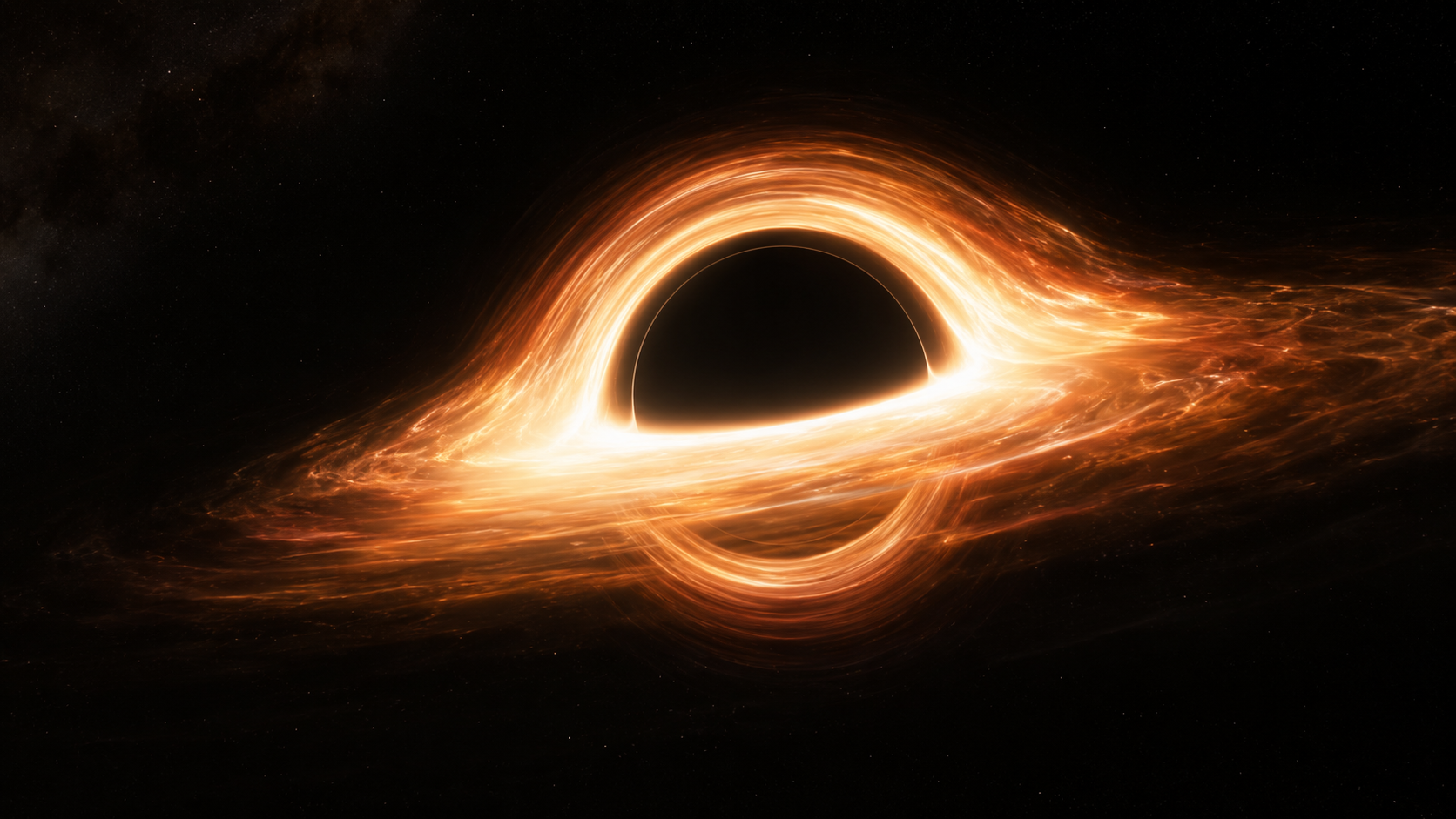
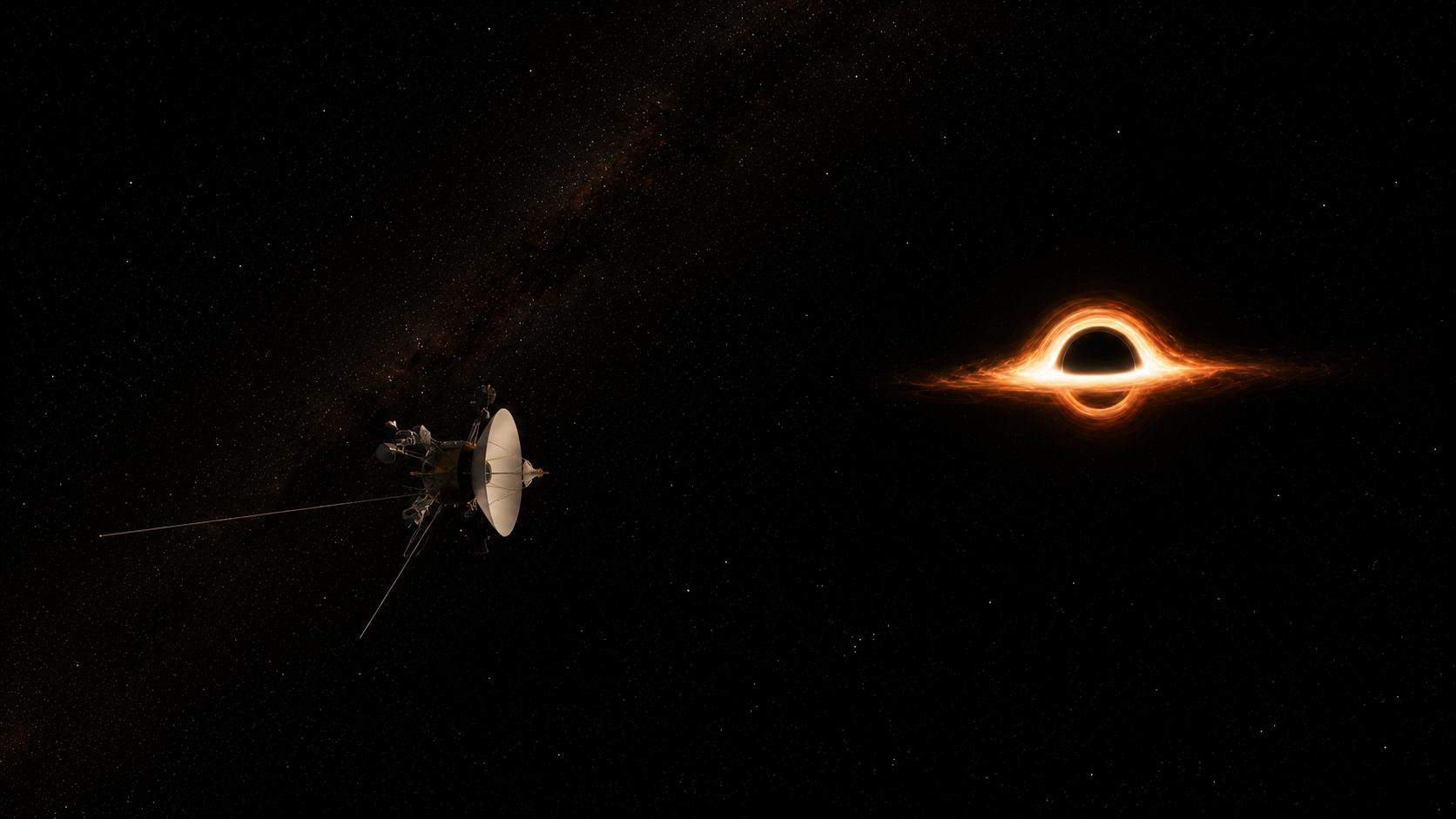
As the spacecraft approaches, gravity bends the path of light. Part of the disk that would otherwise be hidden behind the shadow can appear above and below it. These are not three different disks: it is the same light arriving along different paths.
Narrow bands produced by photons that nearly became trapped in orbit may also appear. The result is a visually strange landscape, but one that can be explained by general relativity — without inventing portals or shortcuts to other universes.
For someone watching from far away, time seems to slow down
A distant observer would receive increasingly faint and redshifted signals. The spacecraft would appear to slow down as it approached the horizon. This does not mean the traveler would literally freeze forever; it means that the spacecraft’s light would become progressively harder to detect.
For the person falling, the local clock continues to work normally during the crossing. It is one of the most counterintuitive parts of the story: different people describe the same fall using different times.
After the horizon: there is no way back
Inside the horizon, all future paths lead toward deeper regions. Starting the engines, turning the spacecraft around and pointing outward does not solve the problem: “outward” is no longer a possible destination.
It is like trying to swim against a current after the river itself has begun to fall. The metaphor is imperfect, but it helps show why this is not simply a matter of finding a more powerful engine.
Spaghettification: a funny name for a serious problem
Tidal forces can stretch a body in the direction of the center and compress it sideways. This process is known as spaghettification. In stellar-mass black holes, it can begin before the horizon. In a supermassive black hole, the crossing may happen first and the physical destruction later.
What NASA’s simulation shows
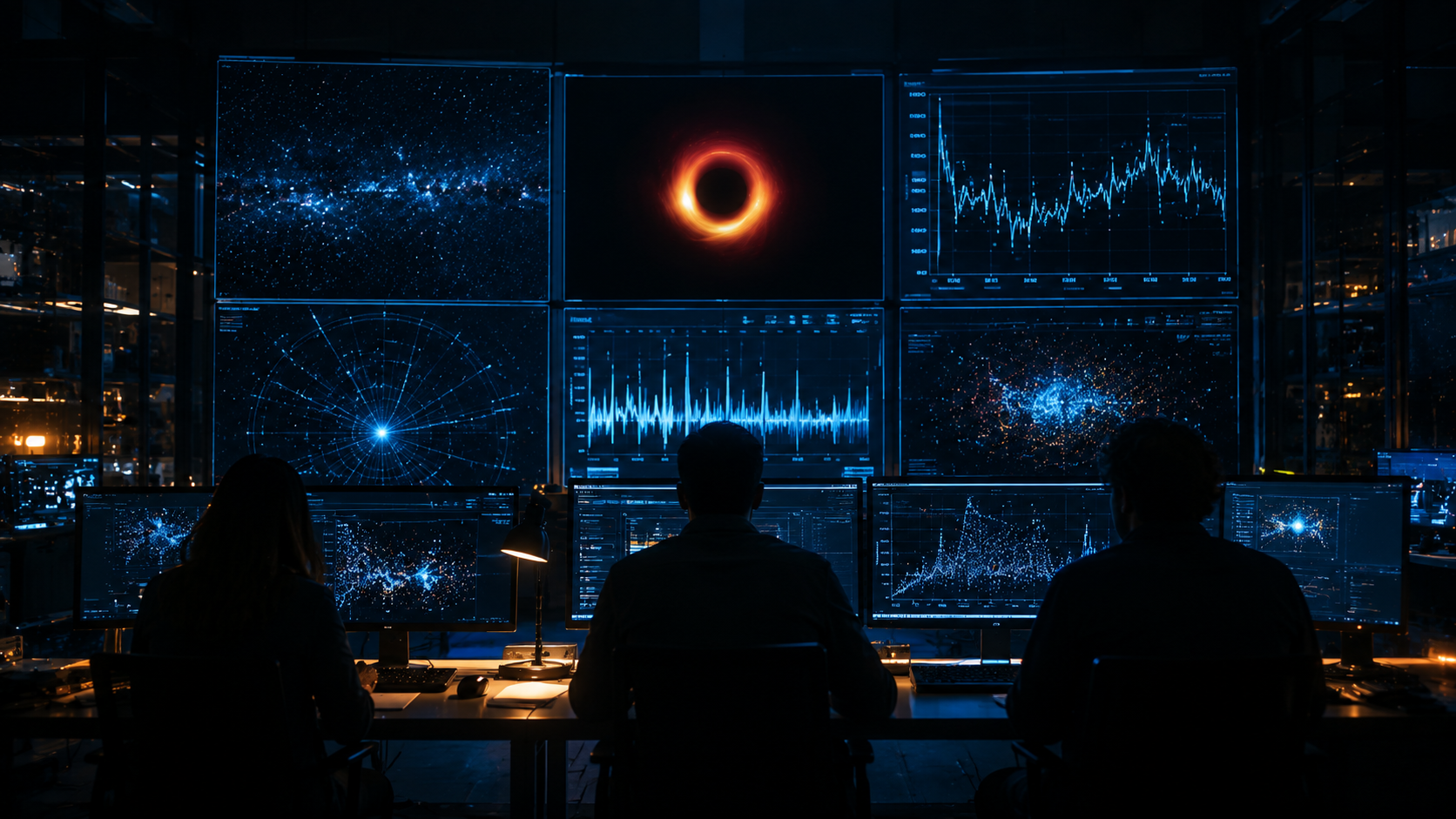
A scientific visualization from NASA follows a camera falling toward a supermassive black hole with about 4.3 million solar masses. In the trajectory chosen by the simulation, the camera takes approximately three hours to reach the horizon and is destroyed about 12.8 seconds after crossing it.
Those numbers belong to that model and trajectory. They are not a universal rule for every black hole. The simulation is valuable precisely because it turns abstract concepts — the curvature of light, the horizon and tidal forces — into an understandable visual sequence.
And then?
General relativity describes a fall toward a singularity, but “infinite density” is not a confirmed photograph of a black hole’s interior. It may be a sign that our equations have reached the limit of their validity.
Moving forward would require reconciling relativity and quantum mechanics. We still do not have a confirmed theory that completely describes this regime. Any portal or secret shortcut beyond this point belongs to fiction, not to an established scientific conclusion.
Frequently asked questions
Would a person be destroyed immediately?
It depends on the black hole’s mass and the trajectory. Tidal forces tend to be stronger near smaller black holes; in a supermassive black hole, crossing the horizon may happen before destruction.
Could someone see the future of the universe during the fall?
Not as a complete broadcast of everything that will happen. Relativity predicts very counterintuitive effects involving time and light, but that is not the same as watching the entire future of the cosmos.
Are black holes portals?
There is no observational evidence that they are portals to other universes. That is a common idea in science fiction, not a confirmed result.